Artificial Intelligence (AI) is transforming nearly every modern industry, and digital compliance is no exception. For years, web accessibility testing followed a rigid, binary formula. You either ran a basic automated scanner that checked for simple code compliance, or you hired a specialist to manually click through your website page by page.
But as modern websites grow more complex with dynamic layouts, real-time data refreshes, and single-page applications traditional testing methods are struggling to keep pace. The 2026 WebAIM Million Report highlights the scale of this challenge: an overwhelming 95.9% of the top 1 million homepages still fail basic WCAG compliance checks. Even more startling is page complexity itself; the average homepage now contains 1,437 individual elements, a massive 22.5% increase in just one year.
To handle this massive explosion of digital data, organizations are turning to AI-powered accessibility testing tools. Let’s break down exactly how AI is changing the landscape, what it can do, and why a “human-in-the-loop” model remains completely irreplaceable.
The Core Evolution: From Simple Rules to Contextual Intelligence
To understand why AI is a game-changer, it helps to look at how traditional automated testing works. Standard testing engines evaluate websites using fixed, deterministic rules.
For instance, a traditional scanner checks an image’s HTML code to see if an alt attribute exists. If the code says alt=”image”, the traditional tool registers a “pass.” However, a human user using a screen reader hears the word “image” read aloud, which provides zero helpful context.
AI shifts the paradigm from strict rule-matching to semantic and contextual understanding. According to the 2026 State of Digital Quality in Accessibility Report by Applause, 79% of software development, QA, and compliance professionals state that their organizations now actively use AI to improve digital accessibility. Rather than simply verifying that a tag exists, machine learning models can evaluate whether the content inside that tag actually makes sense within the context of the page.
3 Major Ways AI Is Accelerating Compliance Testing
1. Smart Automated Alternative Text (Alt Text) Generation
One of the most time-consuming aspects of web compliance is writing descriptions for thousands of e-commerce product photos or media assets.
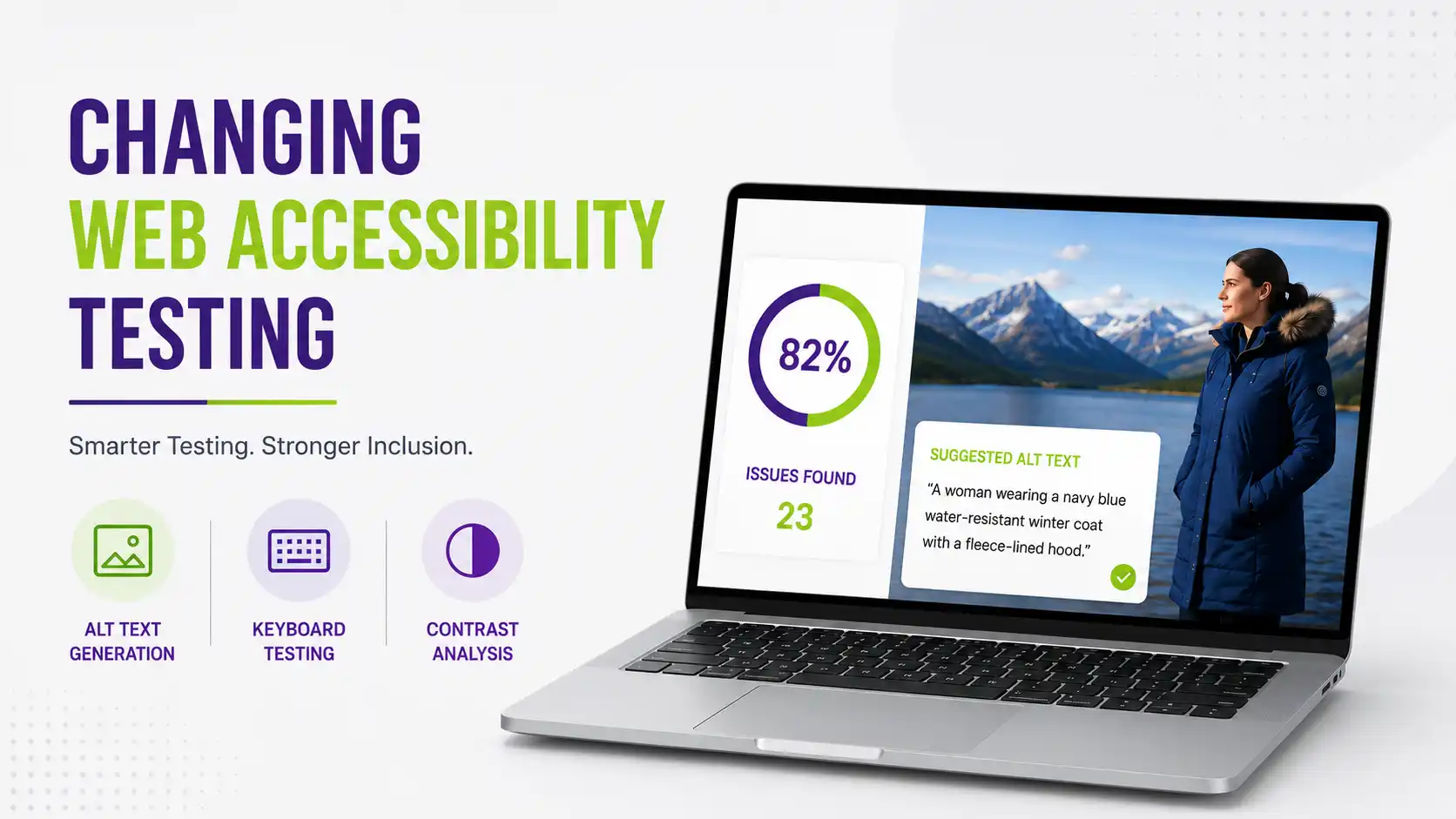
- The AI Advantage: Modern computer vision models can analyze an image and instantly generate highly accurate, contextual alt text. Instead of leaving an image blank, AI can recognize a photo and write: “A woman wearing a navy blue water-resistant winter coat with a fleece-lined hood.”
2. Identifying Complex UI Layout and Keyboard Obstacles
Traditional testing tools struggle to predict how interactive web elements like pop-up modals, drop-down navigation menus, or custom checkout steps behave when someone uses a keyboard instead of a mouse.
- The AI Advantage: Advanced AI testing agents can simulate complex human user journeys. They can automatically “tab” through a website to predict keyboard traps (where a user gets stuck inside a menu and cannot escape) or flag instances where the visual tabbing order doesn’t match the logical reading order of the code.
3. Advanced Color Contrast Detection on Dynamic Backgrounds
Standard scanners can check the contrast ratio of black text on a solid white background with ease. But what happens when your text sits on top of a dynamic image carousel, a video background, or a gradient?
- The AI Advantage: AI testing engines can scan web pages across multiple screen resolutions and dynamic states, catching transient color contrast violations that standard tools miss entirely.
Why AI Alone Falls Short: The “Human-in-the-Loop” Necessity
Because AI tools are highly scalable, many teams fall into the dangerous trap of assuming an AI tool can fix all compliance problems automatically. However, AI lacks human empathy, nuance, and lived experience. It cannot tell you if a complex workflow feels intuitive, or if a dynamic widget genuinely functions for a person with a disability.
In fact, industry data shows that automated AI systems miss up to 60-70% of qualitative accessibility barriers, such as logical reading order, complex keyboard focus trap nuances, and assistive technology compatibility issues.
This is exactly why technology alone is not enough. True digital inclusion requires a strict Human-in-the-Loop (HITL) process. At Tranistics, AI automated tools are used strictly as a first-line accelerator to scan massive volumes of web pages rapidly. The real heavy lifting, identifying, validating, and diagnosing the root causes of compliance errors, is placed entirely in the hands of qualified human auditors.
The Gold Standard: DHS Trusted Testers for Section 508
To guarantee absolute compliance and legal safety, human validation must be rigorous. A general QA tester may not understand the deep intricacies of federal accessibility mandates.
Accessibility Validation Standards Matrix
| Testing Method | Compliance Security | Nuance Detection |
| AI Scanning Only | Low / Incomplete | Programmatic Issues Only |
| DHS Trusted Tester | Absolute / Safe | Comprehensive Human Validation |
The remediation and audit framework utilizes highly trained specialists, including Department of Homeland Security (DHS) Trusted Testers certified in Section 508 compliance.
What is a DHS Trusted Tester?
A DHS Trusted Tester is a certified professional who has completed rigorous training based on the Interagency Trusted Tester Program (ITTP). This methodology provides a repeatable, verifiable, and highly detailed process for testing electronic and information technology to ensure it meets Section 508 standards.
When a DHS Trusted Tester reviews your code, they go far beyond what any AI algorithm can achieve:
- They manually test your site using actual screen readers like JAWS, NVDA, and VoiceOver to evaluate the true auditory user experience.
- They verify that complex forms, interactive dashboards, and transaction funnels are completely usable without a mouse.
- They eliminate the “false positives” and “false negatives” that AI tools frequently spit out, ensuring your development team only spends time fixing real, high-priority issues.
By pairing high-velocity AI automation with elite, federal-grade human expertise, organizations achieve a bulletproof compliance strategy that satisfies both user experience needs and legal requirements.
Preparing Your Website for the Future
AI is making web accessibility testing faster and more scalable than ever before. For businesses looking to keep pace with tightening regulations, adopting AI-driven testing is a great way to catch basic programmatic bugs early.
However, the golden rule of digital accessibility remains unchanged: technology builds the speed, but human expertise ensures accuracy.
To discover how a powerful combination of smart automation and certified DHS Trusted Testers can secure your digital assets, explore the specialized testing and remediation frameworks available through Tranistics.