When an organization decides to prioritize digital compliance, the very first operational step is to conduct an audit. You cannot fix compliance errors until you know exactly where they are. However, this is usually where business leaders hit a major crossroads.
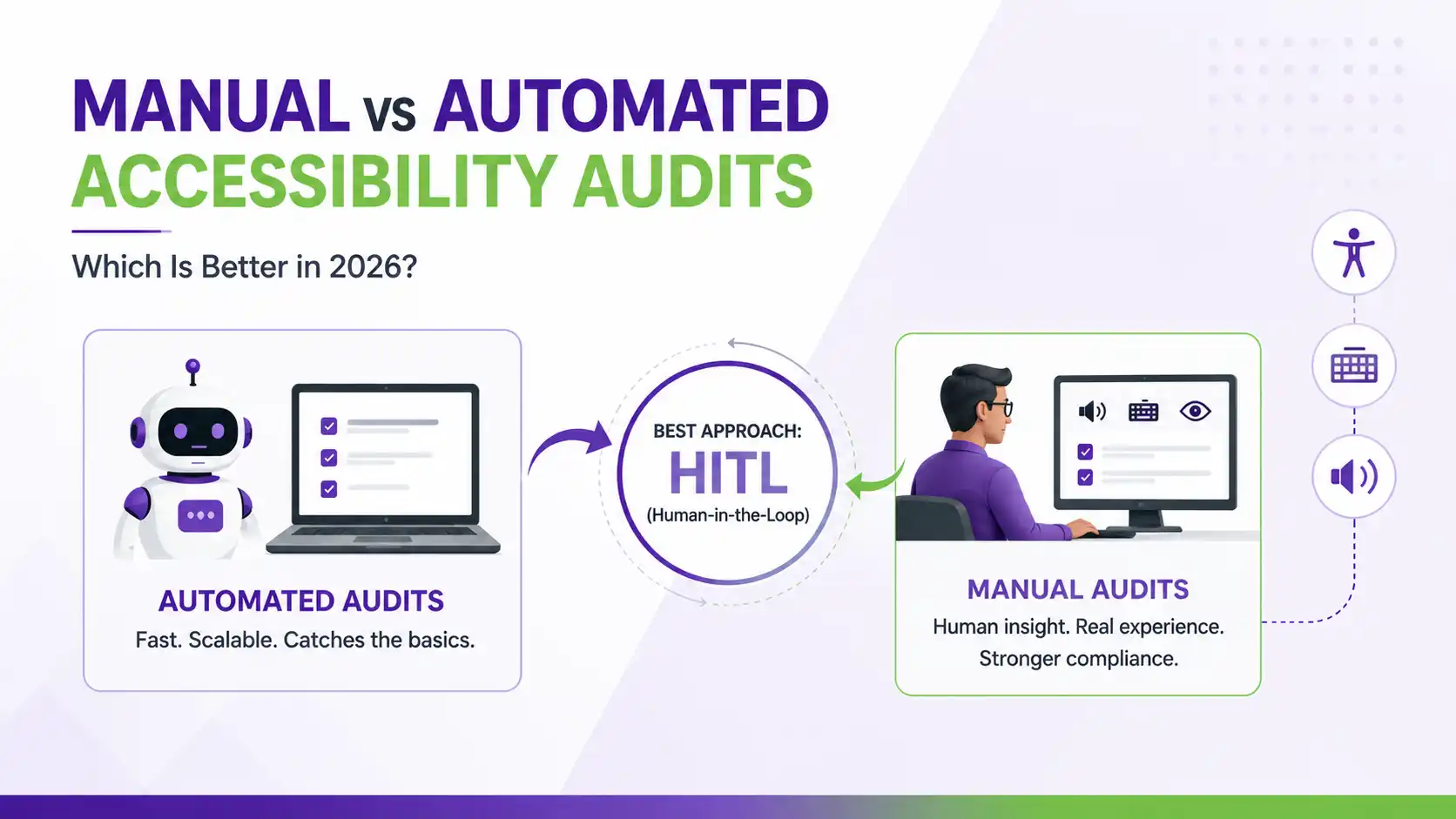
On one side, software teams often push for an automated accessibility audit, pointing out that automated scanners are fast, cheap, and can parse thousands of pages in seconds. On the other side, legal and compliance risk officers push for a manual accessibility audit, arguing that automated tools miss critical legal vulnerabilities that leave the company exposed to litigation.
With over 5,000 ADA website accessibility lawsuits filed across federal and state courts in 2025 alone (UsableNet), choosing the wrong auditing method isn’t just an inconvenience; it’s a major financial and legal risk.
So, which approach is genuinely better? Let’s look at the data, look past the marketing hype, and break down how the industry’s most inclusive brands handle testing in 2026.
The Reality of Automated Accessibility Audits
Automated tools are software scanners that crawl a website’s code to flag programmatic violations. Popular examples include open-source engines like axe-core or Lighthouse, as well as various AI-driven enterprise scanners.
What Automation Does Well
Automation is unbeatable when it comes to raw speed and numerical calculation.
- High-Volume Code Scanning: An automated scan can evaluate a 10,000-page enterprise website in minutes. Doing this page by page manually would take a human auditor weeks.
- Exact Mathematical Violations: Automated tools achieve an incredible 98% accuracy rate when detecting color contrast failures (WebAIM Automated Testing Analysis). They instantly calculate the exact contrast ratio between text and background pixels across an entire platform.
- Catching the Basics: They are highly efficient at flagging clear-cut code omissions, such as a completely missing language tag (<html lang=”en”>) or missing form labels.
The Massive Blind Spot of Automation
Despite advancements in machine learning, independent research reveals a stark limitation: traditional automated testing tools only detect 30% to 40% of all WCAG errors (GovTech Accessibility Report).
Accessibility Issue Detection Gap – 2026 Data
Detected by Automation (30-40%) ◄── Catches: Color contrast, missing tags
Missed by Automation (60-70%) ◄── Requires Human Nuance: Keyboard flow, meaningful alt text, interactive logic
Why is the failure rate so high? Because half of all WCAG success criteria require human context, nuance, and subjective judgment that software cannot replicate.
For example, an automated tool can verify that an image has alternative text (alt=”logo”). It cannot tell you if that description makes any sense. If the image is actually a chart showing quarterly sales data, a screen reader user who hears “logo” is left completely in the dark. The scanner marks it as a “pass,” while the real-world user experiences a total barrier.
The Reality of Manual Accessibility Audits
A manual audit involves a human accessibility specialist interacting with your website exactly like a user with a disability would. They navigate the site using keyboard controls alone, test complex workflows using actual screen readers, and evaluate the clarity of interactive layouts.
What Manual Audits Do Well
Manual audits find the high-stakes, qualitative barriers that trigger lawsuits. According to industry data compiled by Level Access, manual testing discovers 60% to 70% more issues than automated scanning alone.
- Interactive Element Testing: Humans can evaluate whether complex dynamic components like pop-up cookie banners, drop-down menus, and multi-step shopping carts cause “keyboard traps” where a user gets stuck and cannot escape.
- Logical Reading Order: A human auditor ensures that as a screen reader processes a page, the audio layout matches a logical flow.
- Real Context Over Code Rules: A human can verify whether error messages, interactive fields, and structural headings actually make sense to a visitor.
The Downside of Manual Audits
Manual testing is human-intensive. It requires deep expertise, takes longer to execute, and because it is highly comprehensive, it comes with higher upfront costs than running a free software scan.
The Winner? The Human-in-the-Loop Hybrid Model
If automation is too shallow but manual testing is too labor-intensive to run constantly, what is the solution?
The industry gold standard for modern web compliance is a Human-in-the-Loop (HITL) hybrid strategy. In fact, Applause’s 2026 State of Digital Quality Report found that while 79% of organizations use automated tools to accelerate their workflows, an overwhelming 89.3% still validate those results with human testers.
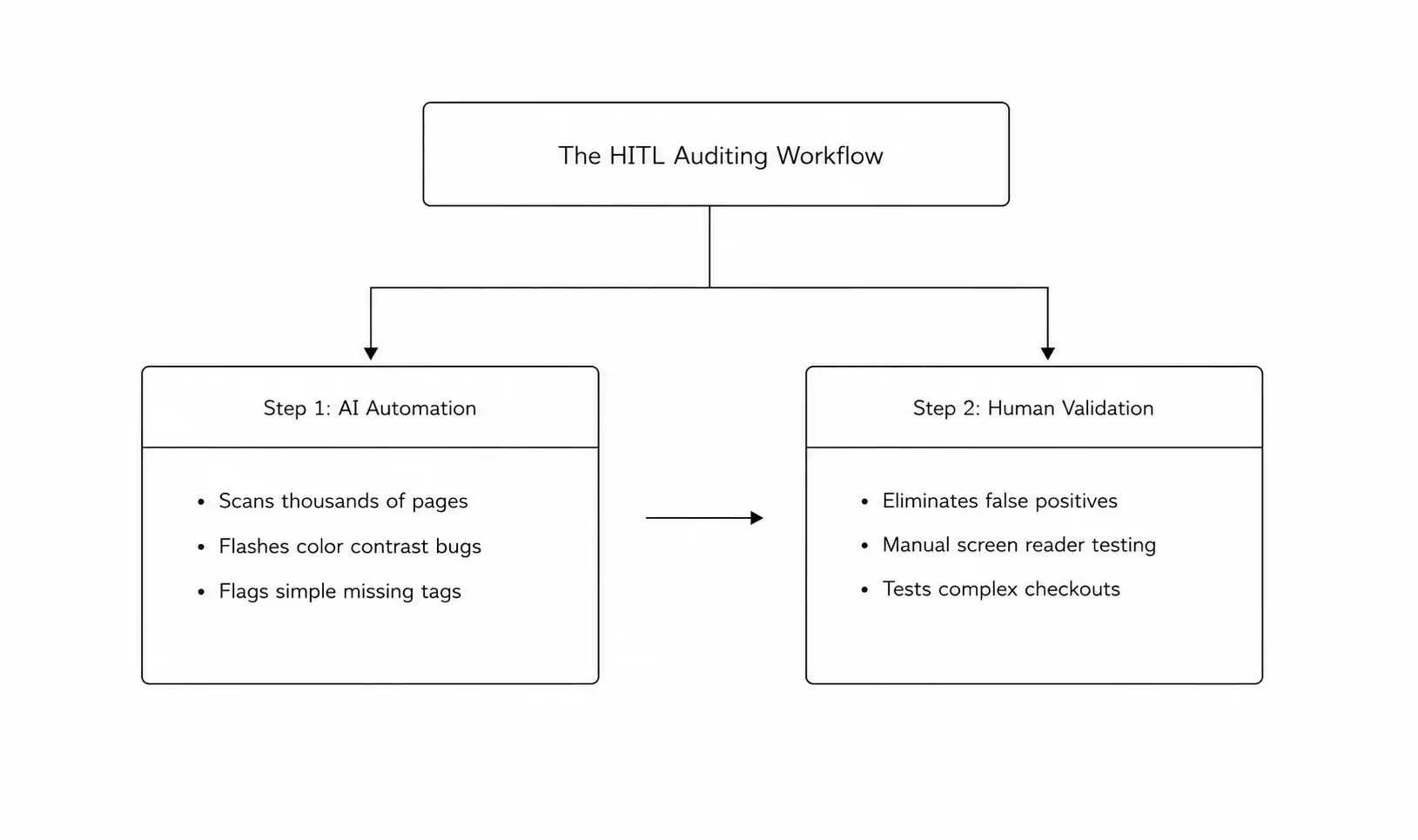
At Tranistics, automation is treated as a high-speed diagnostic tool rather than a final solution. Smart AI engines are deployed to instantly crawl your site’s infrastructure and filter out high-volume programmatic bugs.
Once that foundational data is gathered, human expertise takes over. Certified human auditors step in to analyze the remaining 60-70% of qualitative criteria, eliminating the false positives that waste your developers’ time and ensuring your user paths are genuinely inclusive.
The Ultimate Safeguard: DHS Trusted Testers for Section 508
To truly bridge the gap between automated speed and manual precision, the qualifications of the human eye on your code matter immensely. A standard quality assurance engineer may lack the specific training required to navigate complex legal compliance frameworks.
To provide absolute legal and technical security, the hybrid auditing framework relies on Department of Homeland Security (DHS) Trusted Testers certified in Section 508 compliance.
Learn more about- How AI Is Changing Web Accessibility Testing
The DHS Trusted Tester Advantage
A DHS Trusted Tester is a digital compliance expert who has mastered the Interagency Trusted Tester Program (ITTP) methodology a strict, repeatable, federal-grade protocol for testing web applications.
When a certified DHS Trusted Tester reviews your platform, they deliver a definitive evaluation:
- Physical Screen Reader Execution: They test your site across multiple environments using standard hardware tools like JAWS, NVDA, and VoiceOver to analyze exactly what an auditory user encounters.
- Elimination of Audit Noise: Automated tools routinely generate misleading alerts. Certified testers verify every flag, ensuring your product roadmap only focuses on real barriers.
- Ironclad Legal Documentation: By utilizing a testing standard backed by federal methodology, your business gains verified compliance documentation that helps protect against predatory ADA Title III litigation.
Building a Pragmatic Auditing Strategy
If your goal is to achieve true compliance without breaking your budget or stalling your engineering pipeline, don’t choose between manual and automated testing. Use them together.
Deploy automated tools to monitor your daily content changes, catch simple errors, and maintain a baseline. But when it comes to verifying your core code architecture, updating your transactional workflows, or securing legal protection, rely on expert-led human verification.
To learn how a powerful combination of automated diagnostics and certified DHS Trusted Testers can safeguard your digital presence, explore the full suite of accessibility auditing services available at Tranistics.