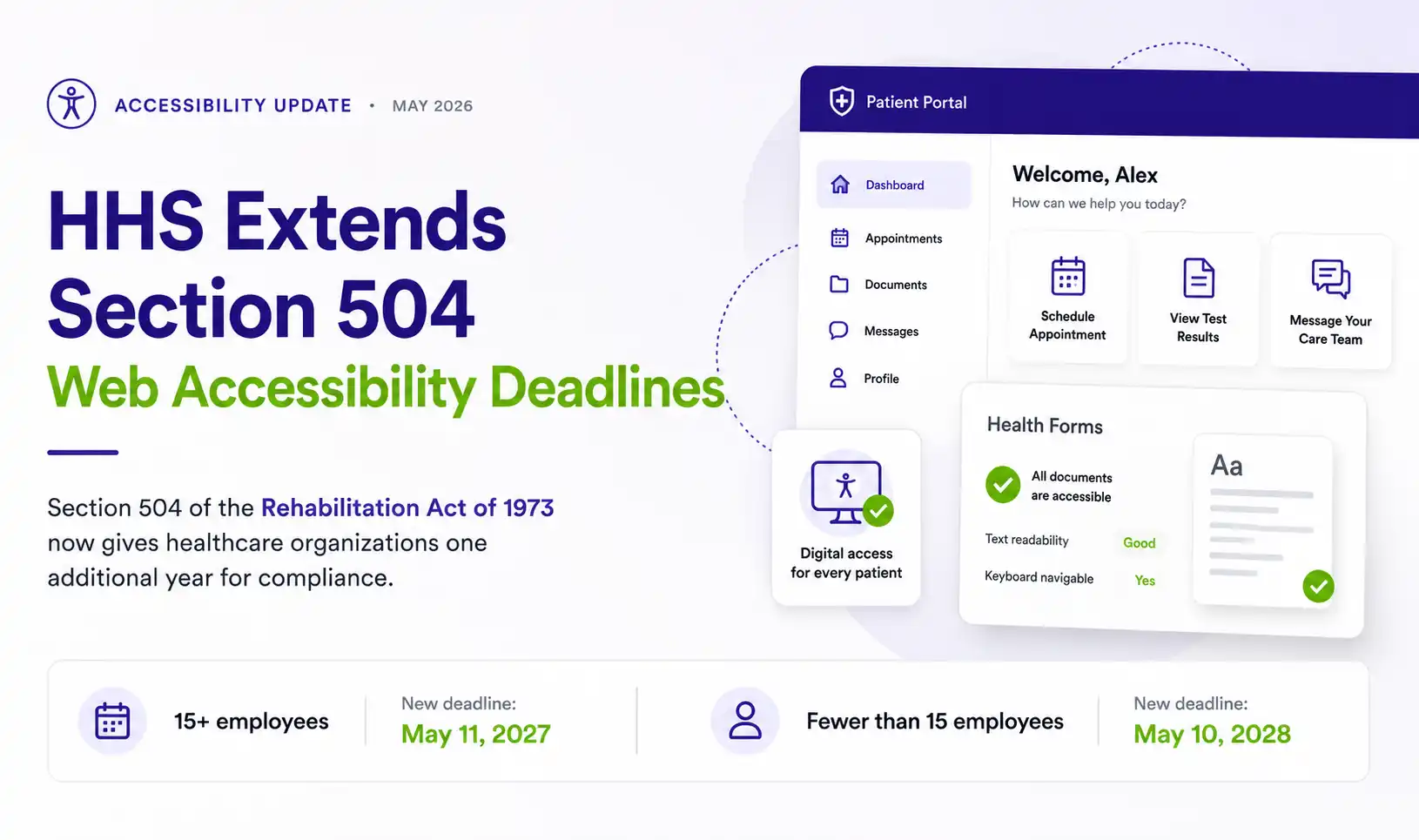
On May 7, 2026, the Department of Health and Human Services published an Interim Final Rule extending both Section 504 digital accessibility compliance deadlines by one year. The rule took effect immediately, four days before the first deadline was supposed to hit.
If your organization receives any form of federal financial assistance from HHS, and if you are in healthcare, higher education, social services, or research, you almost certainly do, this directly affects you. Here is what you need to know.
What Changed
In May 2024, HHS published a sweeping Final Rule updating Section 504 of the Rehabilitation Act of 1973. It was the first major update to these regulations in over 50 years. Among its provisions, the rule required every recipient of HHS funding to make their websites and mobile apps meet a specific technical standard: WCAG 2.1, Levels A and AA.
The original rule set two compliance deadlines based on organization size. Four days before the first one, HHS moved both dates back by twelve months.
| Organization Size | Old Deadline | New Deadline |
|---|---|---|
| 15 or more employees | May 11, 2026 | May 11, 2027 |
| Fewer than 15 employees | May 10, 2027 | May 10, 2028 |
HHS gave two primary reasons. First, it received reports that a significant number of recipients, including community health centers, hospitals, and primary care centers, faced implementation challenges that would have prevented timely compliance. These included PDF remediation backlogs, staffing limitations, and third-party vendor dependencies.
Second, HHS deliberately aligned its timeline with the Department of Justice’s parallel extension of the ADA Title II web accessibility rule, ensuring consistency for entities covered by both laws.
Related: The DOJ Made the Same Move Three Weeks Earlier
On April 20, 2026, the DOJ extended the ADA Title II web accessibility deadline by one year for state and local governments. These two extensions are part of a coordinated federal approach. If your organization falls under both laws, many hospitals, universities, and public entities do, both timelines have now shifted together.
How We Got Here: 53 Years of Section 504
What Changed vs. What Did Not
What Changed
- WCAG compliance deadlines pushed back by one year
- 60-day public comment period opened (closes July 6, 2026)
- Timeline aligned with DOJ's ADA Title II extension
- HHS acknowledged implementation challenges among recipients
What Did Not Change
- WCAG 2.1 Levels A and AA still the standard
- Private right of action: people can still sue
- OCR can investigate proactively without a complaint
- Section 504 obligations active since 1973
- Scope: all HHS-funded programs and activities
The 2024 Final Rule did not create a new obligation. Section 504 has prohibited discrimination against people with disabilities in federally funded programs since 1973. What the 2024 rule did was set a measurable technical standard, WCAG 2.1, and attach a compliance date to it.
The extension moved the date. It did not change the standard, reduce the scope, or suspend the underlying law. The IFR itself states explicitly that it “does not relieve recipients of their other obligations under Section 504,” including the duty to make reasonable modifications to ensure accessibility.
The private right of action is especially important here. The Supreme Court confirmed in Barnes v. Gorman (2002) that Section 504 is privately enforceable in federal court. Private plaintiffs can seek injunctive relief and attorneys’ fees. HHS itself cited the risk of private litigation as one of the reasons for extending the deadline. It is worried about what happens when a significant number of recipients miss the date.
That concern does not disappear because the date moved. It moves with it.
Who Is Covered: And the Reach Is Broader Than You Think
Section 504 applies to any program or activity that receives federal financial assistance from HHS. That covers a far broader range of organizations than most people realize.
Hospitals and Health Systems
Any hospital accepting Medicare or Medicaid, which is nearly all of them, is covered. Websites, patient portals, mobile apps, and kiosks must meet the standard.
Community Health Centers and Clinics
FQHCs and primary care centers receiving HHS grants are directly covered. These organizations were specifically cited in the IFR as facing compliance challenges.
Universities and Research Institutions
Medical schools, research universities, and any educational institution receiving HHS funding fall under the rule. Course materials, portals, and digital tools are in scope.
Human Services Programs
State child welfare programs, Medicaid enrollment systems, mental health centers, and long-term care facilities. Any program funded by HHS.
Vendors and Contractors
The rule covers services provided through contractual, licensing, or other arrangements. If you sell software to HHS-funded entities, your product is in scope.
Health Plans and Insurers
Insurers that receive HHS financial assistance are covered. Digital enrollment tools, member portals, and plan information must be accessible.
One critical detail: a single Medicare Part B payment can be enough to trigger coverage. The threshold of 15 employees determines your compliance deadline, not whether you are covered. A small clinic with eight employees that accepts Medicaid is subject to this rule. It simply has until May 2028 rather than May 2027.
It Is Not Just Websites
The scope of the Section 504 digital accessibility rule extends beyond websites. It covers mobile apps, electronic documents like PDFs, and kiosks used for check-in, payment, or wayfinding.
For kiosks specifically, HHS suggests applying WCAG 2.1 to the software layer but does not specify a hardware standard. The European EN 301 549 standard offers a credible framework for kiosk hardware accessibility and may be useful for procurement decisions.
The rule also requires a designated Section 504 compliance employee and established grievance procedures for handling disability-related complaints. If your organization does not have these in place, the deadline for setting them up was July 8, 2024, when the rule first took effect. That part was never extended.
The Bigger Picture: A Coordinated Federal Push
This extension did not happen in isolation. Three weeks earlier, the DOJ extended the ADA Title II web accessibility deadline by the same one-year margin. HHS explicitly said it aligned its timeline with the DOJ’s action “ensuring consistency for entities covered by both laws.”
Together, these two rules represent a coordinated federal effort to establish WCAG 2.1 AA as the recognized digital accessibility standard across all publicly funded services, whether governed by the ADA, the Rehabilitation Act, or both.
The message from both agencies is the same: digital accessibility is no longer optional. The timeline shifted. The expectation did not.
And just like the DOJ, HHS has signaled that it may consider whether additional rulemaking is needed. The 60-day comment period is the window to influence that conversation.
The Public Comment Window Is Open
Anyone can submit comments to HHS before July 6, 2026. Search for the docket or reference number below:
Submit via regulations.gov
What You Should Do Now
Your Section 504 Accessibility Action Plan
Section 504 has protected people with disabilities from discrimination in federally funded programs for over 50 years. A one-year extension does not change the law, the standard, or the expectation.
The deadline moved. The obligation did not. Keep going.